
 , Idrosandblasters
 , Graffiti removal
 , Facades Cleaning
 , Conservative Cleaning
 , Cleaning
 , Industry
 , Nautical
 , Stone
 , Bodywork

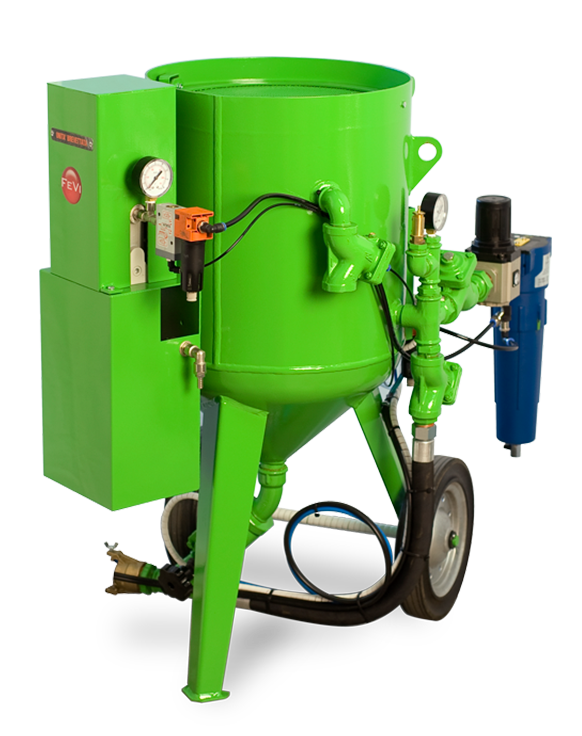
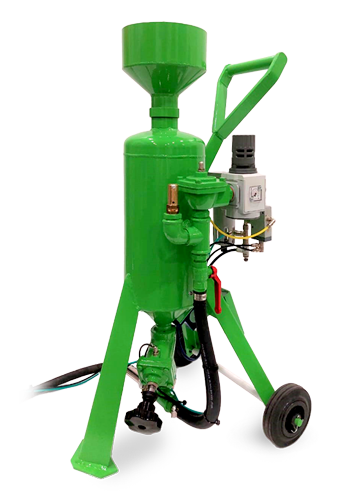
FEVI wet blasting machines
Wet blasting is a technology that combines compressed air, abrasive and a controlled quantity of water to treat surfaces while significantly reducing dust dispersion compared with conventional dry blasting.
It is used for the removal of rust, paint, coatings and residues and for surface preparation in construction, industry, marine applications, maintenance and restoration.
Wet blasting and water blasting are often used as equivalent expressions, but they can refer to different technical configurations. The main distinction concerns the role of water within the process: in some systems water acts as the main carrier, whereas in wet blasting with abrasive pre-dampening it is added to the air-abrasive stream mainly to help contain airborne particles.
Understanding this difference makes it possible to select the most suitable system according to the surface, required result, availability of compressed air and water, and the conditions of the working environment.
To view the available FEVI systems directly, visit the FEVI wet blasting machines.
How wet blasting works
In wet blasting, the abrasive is accelerated by compressed air in the same way as in a conventional blasting system.
Water is introduced into the process to capture a significant proportion of the particles generated when the abrasive impacts the surface.
The process can be summarised as:
compressed air + abrasive + water → dampened abrasive stream
The mechanical action of the abrasive therefore remains the main element responsible for material removal, while the water primarily helps control dust and changes the conditions in which the treatment takes place.
The quantity of water required depends on the technology used and the application.
What is water blasting?
The term water blasting is commonly used to describe systems in which water and abrasive are mixed and projected onto the surface.
Different technical configurations are available.
In some systems, abrasive is drawn into the flow through a Venturi effect generated by the water; in others, water and abrasive are combined inside specific equipment.
Water therefore plays a more significant role than in pre-dampening systems applied to a pneumatic blasting machine.
Water blasting can be used to:
- remove paint;
- treat rust;
- remove residues and encrustations;
- prepare surfaces;
- treat concrete and masonry;
- work on metal structures.
Here too, the choice must take into account the material being treated and the management of water and residues generated by the process.
Wet blasting and water blasting: what is the difference?
The distinction concerns not only the presence of water, but also the way water, air and abrasive participate in the process.
| Feature | Compressed-air wet blasting | Water blasting |
|---|---|---|
| Main source of process energy | Compressed air | Depends on the configuration, often pressurised water |
| Abrasive | Primarily conveyed by air | Mixed with or drawn into the water flow |
| Role of water | Mainly dust suppression | A more significant part of the process |
| Quantity of water | Can be limited | Can be greater |
| Compressor | Required in pneumatic systems | Depends on the system |
| Wastewater management | Required | Required |
| Adjustment capability | Depends on air, abrasive and water | Depends on the configuration |
It is therefore not correct to consider one technology universally superior to the other.
The choice should depend on the application.
Wet blasting and dry blasting
Dry blasting uses compressed air and abrasive without the addition of water.
It provides considerable operating freedom and is particularly suitable when:
- water cannot be used;
- the surface must remain dry;
- wet residues need to be avoided;
- the material is incompatible with moisture.
Wet blasting may instead be preferable where dust containment is particularly important.
The main advantage is therefore not necessarily greater removal capacity, but the possibility of controlling airborne particles more effectively during treatment.
Why water reduces dust
During conventional blasting, abrasive impact generates particles from both the abrasive itself and the surface being treated.
Water captures some of these particles, increases their weight and limits the amount of time they remain suspended in the air.
The level of dust reduction nevertheless depends on:
- quantity of water;
- type of abrasive;
- pressure;
- surface;
- material removed;
- operating method;
- environmental conditions.
For this reason, it is more accurate to refer to substantial dust reduction rather than an automatically dust-free process.
WATER BLAST: blasting with pre-dampened abrasive
FEVI WATER BLAST uses the principle of abrasive pre-dampening, introducing water into the blasting stream to help contain dust during treatment.
The technology therefore retains the mechanical action typical of a pneumatic blasting machine while adding water close to the treatment point.
This configuration can be particularly useful when the aim is to combine:
abrasive capability + mobility + dust reduction.
For available features and configurations, visit the FEVI wet blasting machines.
Which surfaces can be treated?
Wet blasting can be used on many materials, but the operating parameters must be adapted to the surface.
Iron and steel
It can be used to remove:
- rust;
- oxidation;
- paint;
- old coatings;
- surface residues.
When the metal remains wet after treatment, the risk of rapid surface re-oxidation must be considered, particularly before subsequent painting cycles.
Cement and concrete
The technology can be used to remove coatings, residues and contamination or to prepare the surface for subsequent processes. Treatment intensity must be adjusted to avoid unnecessary removal of the substrate.
Stone and natural-stone surfaces
On stone, marble and natural materials, the following should be assessed:
- porosity;
- hardness;
- state of preservation;
- sensitivity to water;
- type of deposit to be removed.
On historic surfaces, carrying out a preliminary test is particularly important.
Brick
Bricks and masonry materials can absorb significant quantities of water. Porosity, condition of the substrate and drying time must therefore be considered.
Wood
The use of water on wood must be assessed particularly carefully because moisture and abrasion can modify the fibres and surface. In many wood applications, controlled dry blasting may be preferable.
Application sectors for wet blasting
Wet blasting in construction
The construction sector is one of the main areas of application. The technology can be used on façades, concrete, brick, stone, metal structures, architectural elements and surfaces affected by paint and coatings.
Dust reduction can provide an important advantage on worksites, particularly where airborne particles need to be contained.
The presence of water nevertheless requires correct management of material reaching the ground or surrounding surfaces.
Façade blasting
When treating façades, the substrate material must first be identified. Stone, brick, concrete, render and coatings have very different levels of resistance. Pressure and abrasive should therefore be adjusted progressively.
Excessively aggressive treatment can modify texture, porosity, colour and surface geometry. Before treating the entire façade, it is advisable to carry out a test on a limited area.
Graffiti removal
Wet blasting can also be used for graffiti removal, particularly where the substrate is compatible with abrasive treatment. Water helps contain particles generated by paint removal and abrasion of the surface.
The difficulty of the operation nevertheless depends on the type of paint, time elapsed since application, porosity, penetration depth and resistance of the substrate. On porous stone or delicate materials, excessive treatment may also remove part of the original surface.
For further details, visit the page dedicated to graffiti removal.
Wet blasting in restoration
In restoration, the addition of water can help manage dust, but compatibility must be assessed case by case. Historic artefacts may feature porosity, salts, fractures, poorly cohesive surfaces, previous treatments, pigmentation or patinas.
Water and abrasive can therefore produce different effects from a dry treatment. The process should be preceded by tests and, for particularly valuable items, defined together with the professionals responsible for the conservation work.
See also the FEVI solutions for the restoration sector.
Wet blasting in marine applications
In the marine sector, the technology can be used on structures and surfaces compatible with abrasive treatment. Applications can include removal of old coatings, treatment of metal components, preparation of selected surfaces and maintenance.
The advantage of dust containment can be particularly useful on site. Here too, abrasive and operating parameters must be selected according to the material being treated.
Industrial applications
In industry, wet blasting can be considered for fabricated metalwork, structures, tanks, metal components, maintenance and surface preparation.
The choice of technology must nevertheless take the entire production process into account. If a component needs to be painted immediately afterwards, for example, drying, contamination and possible oxidation after treatment must be considered.
Which abrasive should be used?
Water does not replace the abrasive.
The abrasive is responsible for much of the mechanical action exerted on the surface.
Selection depends on:
- material being treated;
- coating to be removed;
- required surface profile;
- particle size;
- hardness;
- particle shape;
- compatibility with the nozzle and machine.
Depending on the application and machine, suitable abrasives can include olivine, aluminium oxide and other specific media.
In various FEVI WATER BLAST configurations, OLYBLAST, an olivine-based abrasive, is used.
Why ordinary silica sand should be avoided
In everyday language, the term “sand” is frequently used even when specific technical abrasives are actually being used.
For professional applications, it is important to select materials suitable for abrasive blasting and for the specific process, taking their composition and associated safety information into account.
The abrasive should be selected according to its technical characteristics rather than simply because it is commercially described as sand.
Pressure and intensity in wet blasting
Even with the addition of water, pressure remains a fundamental parameter.
Higher pressure increases the energy of the abrasive stream but may make the treatment excessively aggressive for some surfaces.
The correct value depends on:
- material;
- abrasive;
- nozzle;
- distance;
- contamination;
- required result.
It is advisable to start with conservative parameters and gradually increase the intensity after checking how the surface responds.
Nozzle diameter and compressed air
Nozzle diameter determines the quantity of air required by the machine.
As diameter increases, the required airflow also rises rapidly.
A correctly configured blasting machine connected to an undersized compressor can lose pressure during operation.
For this reason, the following should be assessed together:
blasting machine + nozzle + pressure + compressor airflow.
The compressor's nominal power expressed in HP or kW alone is not sufficient to determine compatibility.
How much water is required?
There is no universal quantity.
It depends on the technology and the level of dust suppression required.
In systems based on abrasive pre-dampening, the objective is to use a controlled quantity of water sufficient to limit dust without turning the process into a predominantly hydraulic jet.
An excessive quantity can increase:
- volume of wet residues;
- collection requirements;
- drying time;
- quantity of water to be managed after treatment.
Adjustment should therefore achieve a balance between dust suppression and worksite management.
Management of water and residues
The use of water does not eliminate process residues.
After treatment, the following may be present:
- abrasive;
- water;
- rust;
- paint fragments;
- contaminants;
- material removed from the surface.
These materials must be collected and managed according to their nature and the operating conditions.
Wet blasting can reduce airborne dispersion, but transfers part of the material into the wet residue generated by the process.
This aspect should be considered during the planning stage of the operation.
Wet blasting and the working environment
Dust reduction can significantly improve worksite management compared with dry blasting.
It does not, however, mean that the technology automatically eliminates every risk.
The following must still be assessed:
- substances being removed;
- characteristics of the abrasive;
- spray;
- noise;
- compressed air;
- surface being treated;
- collected residues;
- possible contamination of the water.
PPE, work-area segregation and operating procedures must be defined through an appropriate risk assessment.
Flash rust after wet blasting
On ferrous surfaces, the use of water can promote the rapid appearance of surface oxidation, commonly referred to as flash rust.
The phenomenon depends on:
- type of steel;
- water quality;
- weather conditions;
- humidity;
- drying time;
- contaminants present.
Where the surface is subsequently to receive paint or another coating, the stages following blasting must therefore be planned correctly.
Advantages of wet blasting
The main operating advantages can include:
- substantial reduction in airborne dust;
- ability to retain the abrasive action typical of blasting;
- use on different surfaces and applications;
- greater control of particles in the working area;
- ability to work in contexts where dust represents an operational issue;
- adjustment of the balance between abrasive action and water quantity.
The actual advantages nevertheless depend on the configuration and application.
Limitations to consider
Wet blasting is not the best solution in every situation.
The following must be considered:
- generation of wet residues;
- need to collect water;
- drying;
- possible corrosion on ferrous metals;
- compatibility of the surface with moisture;
- weather conditions;
- situations in which water cannot be used.
Where these factors are problematic, dry blasting, abrasive recovery blasting or another technology may be preferable.
Wet blasting or abrasive recovery blasting?
The two technologies address dust management in different ways.
Wet blasting uses moisture to capture particles. An abrasive recovery blasting machine instead uses an extraction system that recovers abrasive and dust directly from the surface.
| Requirement | Technology to consider |
|---|---|
| Large surface and freedom of the abrasive stream | Wet blasting |
| Localised operation | Abrasive recovery blasting |
| Irregular geometry | Wet open blasting generally offers greater versatility |
| Immediate abrasive recovery | Abrasive recovery blasting machine |
| Substantial outdoor dust reduction | Wet blasting |
| Regular surface in an indoor environment | Abrasive recovery blasting should be considered |
The choice therefore depends on the surface and operating conditions. For further information, visit the section dedicated to FEVI abrasive recovery blasting machines.
Maintenance of wet blasting machines
Water, abrasive and compressed air require particular attention to the components through which the mixture passes.
The following should be inspected periodically:
- nozzle;
- hoses;
- fittings;
- valves;
- metering system;
- water-introduction system;
- components subject to abrasion;
- condensate separation system.
At the end of the operation, accumulations of wet abrasive should be avoided in areas where they could cause encrustation or irregular operation during subsequent use.
WATER BLAST: when to consider it
A system such as FEVI WATER BLAST can be considered when:
- a substantial reduction in dust dispersion is required;
- the abrasive capability of a pneumatic system needs to be retained;
- water is compatible with the surface;
- the work is carried out in construction or on a worksite;
- iron, stone, concrete or other compatible surfaces need to be treated;
- water and removed material can be managed correctly.
To view the model and updated technical features, visit the range of FEVI wet blasting machines.
Frequently asked questions about wet blasting
What is the difference between wet blasting and water blasting?
Discover the answer
Both combine water and abrasive, but they can use different operating principles. In pneumatic blasting with abrasive pre-dampening, compressed air remains the main carrier of the abrasive and water is added mainly to control dust. In water blasting, water may play a more significant role in carrying and mixing the abrasive.
Does wet blasting completely eliminate dust?
Discover the answer
No. Water can substantially reduce airborne particles, but the level of dust suppression depends on the configuration, surface and operating conditions.
Does wet blasting use a lot of water?
Discover the answer
It depends on the system. Configurations based on abrasive pre-dampening can use smaller quantities than technologies in which water acts as the main carrier.
Can wet blasting be used on iron?
Discover the answer
Yes, but after treatment the risk of rapid surface oxidation must be considered. Drying and subsequent processes should be planned correctly.
Is it suitable for wood?
Discover the answer
Its use should be assessed carefully because water and abrasion can modify the fibres and introduce moisture into the material.
Which abrasive should be used?
Discover the answer
It depends on the surface and required result. Abrasive, particle size, nozzle and pressure should be selected as parts of the same system.
Is a compressor required?
Discover the answer
Yes, in pneumatic systems such as WATER BLAST. The required airflow depends mainly on nozzle diameter and operating pressure.
Does water make blasting less aggressive?
Discover the answer
Not necessarily. Treatment intensity depends mainly on the abrasive, pressure, nozzle and distance. Water primarily helps control airborne particles.
Can wet blasting be used on façades?
Discover the answer
Yes, where the material and state of preservation are compatible. A preliminary test is advisable to define pressure, abrasive and water quantity.
What residues remain after treatment?
Discover the answer
Water, abrasive and material removed from the surface form residues that must be collected and managed according to their composition.
Wet blasting: choose according to the application
Wet blasting makes it possible to retain the mechanical action of the abrasive while significantly reducing dust dispersion through the controlled use of water.
Compared with dry blasting, it changes the operating conditions and introduces additional factors that must be considered: compatibility of the surface with water, residue management, drying and possible oxidation of ferrous materials.
Compared with conventional water blasting, pneumatic pre-dampening systems retain compressed air and abrasive as the main elements of the process, using water primarily to control airborne particles.
The correct choice should therefore start from:
surface → material to be removed → required result → dust to be managed → abrasive → compressed air → availability and management of water.
To compare FEVI configurations dedicated to this technology, visit the range of FEVI wet blasting machines.