

FEVI blast rooms
FEVI blast rooms are designed for companies that need to treat industrial surfaces in a professional, continuous and controlled way.
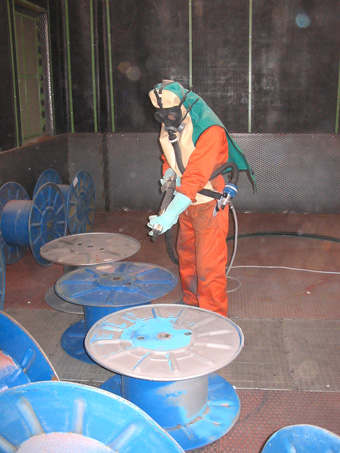
The main function of the blast room is to create a dedicated sandblasting environment where the operator can work on large-sized parts while keeping abrasive, dust, internal visibility, operating safety and residue management under control.
Unlike a portable sandblaster or a compact blasting cabinet, a blast room is designed as a real production system.
The configuration may vary according to the size of the parts, the field of use, the abrasive used, the required recovery system, the work frequency, the available space and the required level of automation.
FEVI manufactures custom blast rooms to meet specific requirements for the treatment, preparation and finishing of industrial parts of different sizes.
They are systems normally composed of the following parts:
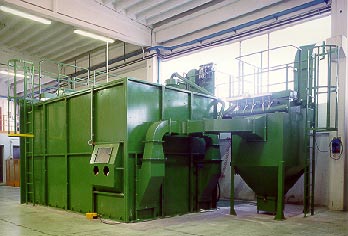
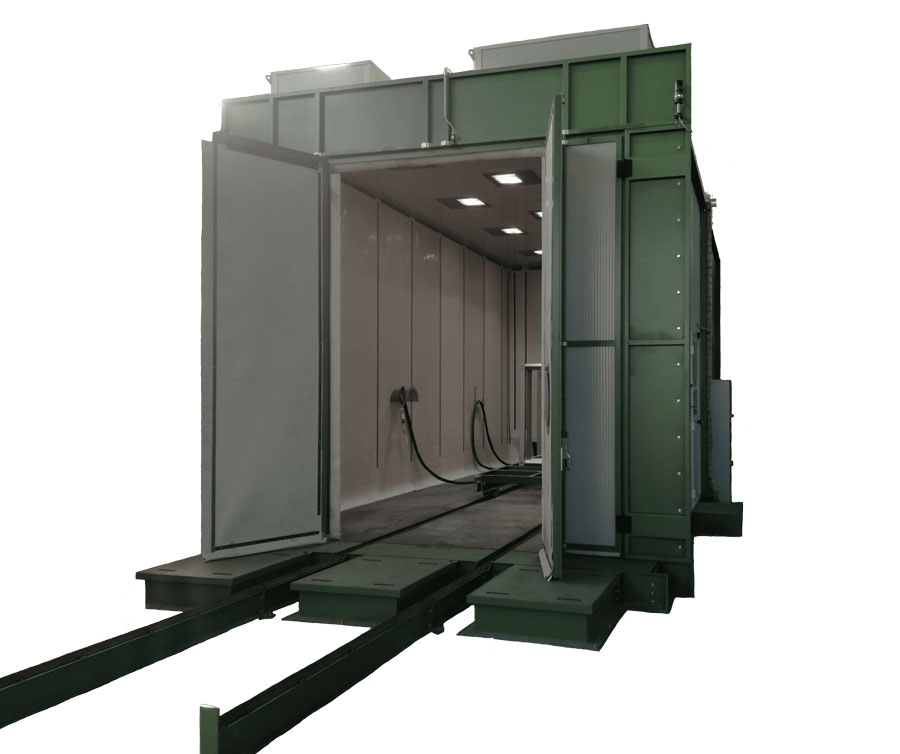
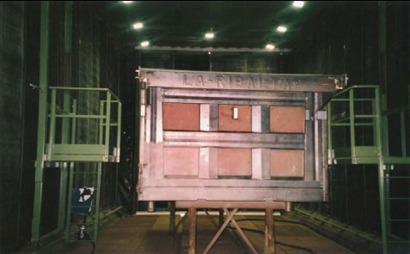
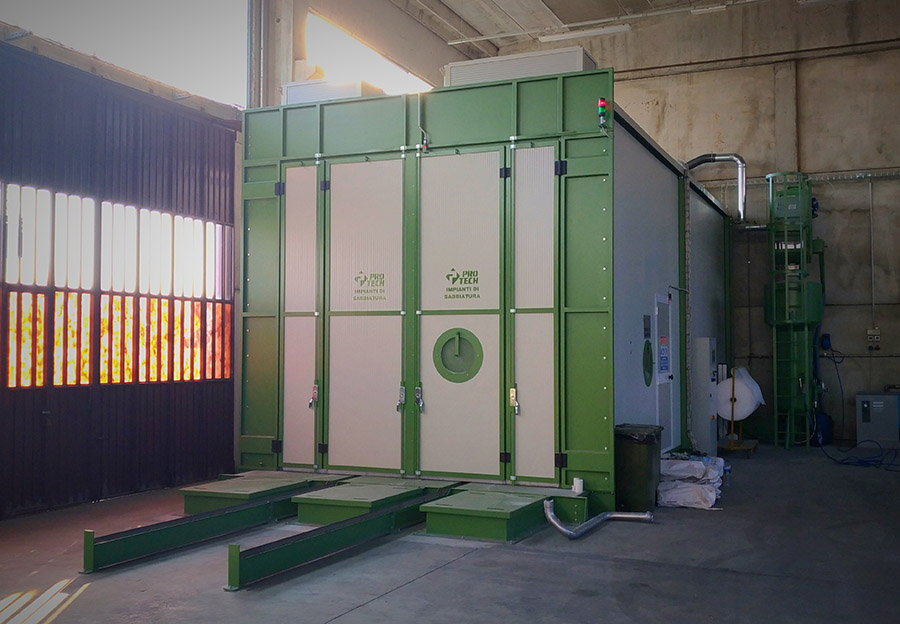
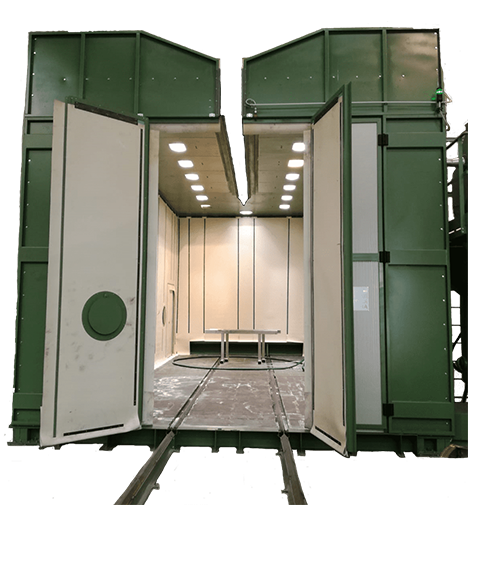
The sandblasting chambers are preferably made with modular press-folded panels with reinforcement ribs that can be assembled by means of bolts.
This solution, more expensive than the welded type, offers the following advantages:
- ease of movement from one place to another
- simplicity in adding a second door
- quick assembly.
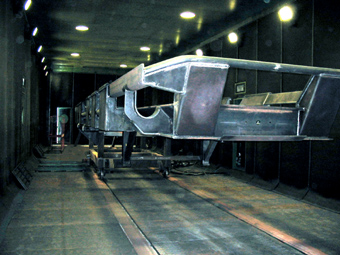
To complete the sandblasting chamber there are a series of lamps of adequate power for internal lighting and the internal coating in anti-abrasive black rubber to protect the walls and to contain noise.
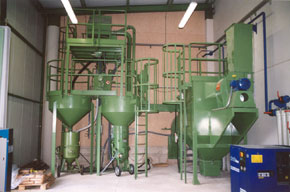
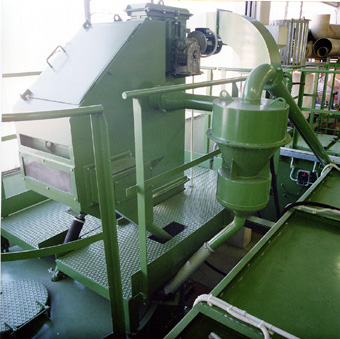
The total recovery system of the scraping type abrasive allows to work non-stop without worrying about the abrasive scattered during the processing of the pieces. The aforementioned system provides for the recovery of the abrasive used, for its cleaning and recycle.
The advantages offered by this type of system are the following:
- long service life of the scraping strips
- perfect cleaning of the tanks
- noiselessness
- extremely low foundation costs (H = 200mm.)
- possibility of placing the recovery system directly on the floor (costs for non-existent foundations)
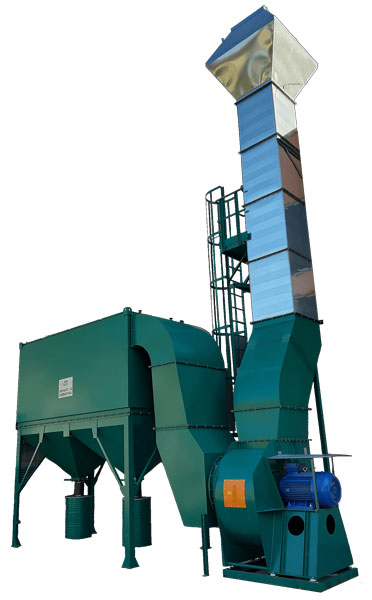
For the dedusting of the sandblasting chambers, our company installs dry dust collectors with self-cleaning cartridges by means of compressed air jets.
During normal maintenance operations the top-loading filter cartridges prevent the operator from accessing the inside of the filter (as per American regulations). This type of filter allows us to ensure excellent visibility inside the sandblasting chambers and also to contain emissions to the exhaust stack within 2/3 mmgr / Nmc max.
The system is completed by a standardised electrical panel designed to avoid abrasive clogging and to ensure control of all electrical equipment
Who they are recommended for
- Metal fabrication companies
- Mechanical companies
- Manufacturing industries
- Structured workshops
- Companies working with iron, steel and stainless steel
- Manufacturers of components and metal structures
- Companies preparing surfaces before painting or coating
- Industrial maintenance departments
- Worksites and plants handling large-sized parts
- Companies that want to recover and reuse the abrasive
Main applications
Sandblasting of metal fabrications
Suitable for processing frames, bases, beams, welded components and large-sized manufactured items.
Preparation before painting
Surface preparation before painting, metallization and protective treatments.
Removal of oxidation and coatings
Removal of rust, oxides, paint and adherent contaminants from metal components.
Stainless steel treatment
Dedicated configurations with suitable abrasives such as glass beads or ceramic media.
Work on large-sized parts
The blast room allows the operator to enter the working area directly.
Abrasive recovery
Systems designed to improve operating order and reuse of the abrasive material.
Why choose a FEVI blast room
Custom design
Each blast room is designed according to the parts, abrasives, available spaces, handling requirements and required productivity.
Modular structure
FEVI manufactures blast rooms with modular press-bent panels, reinforced and assembled with bolts.
Internal anti-abrasive lining
The interior can be lined with anti-abrasive rubber to protect the walls and reduce noise.
Internal lighting
Dedicated lamps improve visibility and control, even on complex or large-sized parts.
Abrasive recovery
The system can be configured with partial, semi-total or total recovery.
Integrated dust extraction
Self-cleaning cartridge dust collectors help maintain internal visibility and dust control.
Integrated sandblaster
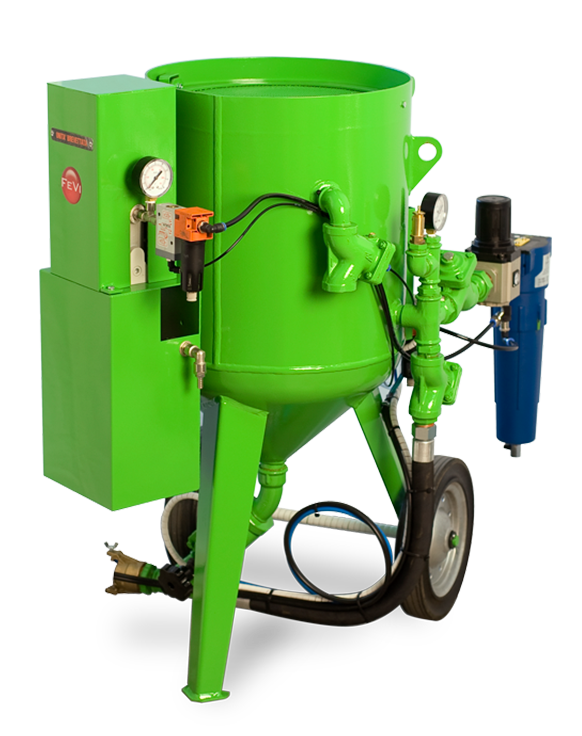
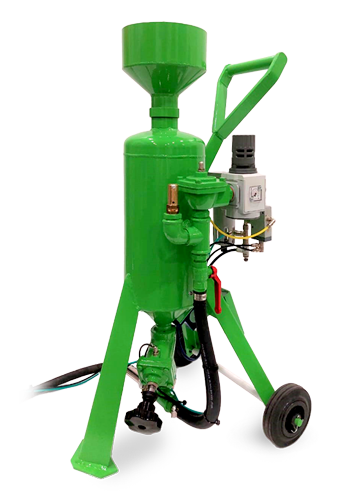
The sandblaster can be configured with remote control and automatic abrasive loading.
Main components of the system
-
Blast room
Main structure made with self-supporting modular panels resistant to abrasion.
-
Abrasive recovery system
Collects, conveys and recirculates the abrasive used during the operation.
-
Abrasive cleaning
Separation of dust, waste and unsuitable particles to improve reuse of the material.
-
Dust collector
Suction and filtration system with self-cleaning cartridges using compressed air jets.
-
Sandblaster with remote control
Configuration designed to make the cycle safer, more practical and more efficient.
-
Electrical control panel
Centralized management of the system equipment and functions.
Types of blast rooms
-
Partial recovery blast room
Recommended when it is not necessary to recover abrasive from the entire surface of the room.
-
Semi-total recovery blast room with tracks
Suitable for trolleys, heavy structures and reinforced passage areas.
-
Total recovery blast room
Complete configuration with abrasive recovery across the entire working area.
-
Blast room for stainless steel
Dedicated configuration with compatible abrasives such as glass beads or ceramic media.
-
Blast room without civil works
Above-floor solution that reduces or eliminates complex structural work.
Difference between a blasting cabinet and a blast room
A blasting cabinet is a closed and compact machine where the operator works from the outside through gloves and a viewing window.
A blast room, on the other hand, is an industrial environment designed to accommodate large-sized parts and allow the operator to physically enter the working area.
- The cabinet is suitable for small or medium-sized parts
- The blast room is suitable for large and heavy manufactured items
- The cabinet is more compact
- The blast room is a custom industrial system
- The cabinet has more defined dimensional limits
- The blast room is designed according to the company’s production requirements
When to choose a blast room
- You need to treat parts that are too large for a standard cabinet
- You work on metal fabrications, frames and large structures
- You need a custom-designed system
- You want to recover and reuse the abrasive
- You want to improve dust management
- You need to organize a dedicated sandblasting department
- You work with iron, steel or stainless steel
- You need to prepare surfaces before painting or coating
- You want to reduce dispersion and manual abrasive handling
- You need a complete integrated system
When to consider another FEVI product
-
Blasting cabinets
For small or medium-sized parts and more limited spaces.
-
Shot blasting cabinets
For dedicated shot blasting and controlled roughening operations.
-
Open blasting machines
For outdoor operations, worksites and surfaces that cannot be enclosed.
-
Recovery sandblasters
To reduce abrasive dispersion during operations.
-
Automatic systems
For repetitive cycles and automated industrial operations.
FEVI blast rooms FAQ
What is a blast room?
A blast room is a closed industrial system designed for operations on large-sized parts.
When is it worth choosing a blast room?
When the parts are too large for a standard cabinet or when a dedicated system with abrasive recovery and dust extraction is required.
Are FEVI blast rooms custom-made?
Yes. The blast rooms are designed according to the parts, abrasive, available space and required productivity.
Is abrasive recovery possible?
Yes. The systems can be configured with partial, semi-total or total recovery.
Is it possible to install a blast room without civil works?
Yes. Some configurations include above-floor systems that reduce or eliminate civil works.
Are the blast rooms suitable for stainless steel?
Yes. FEVI can configure dedicated blast rooms with compatible abrasives such as glass beads or ceramic media.
How is dust managed?
Dust is controlled through suction systems and dust collectors with filter cartridges.
Is a dedicated sandblaster required?
Yes. The blast room is normally integrated with a remote-controlled sandblaster.
Can FEVI help configure the system?
Yes. FEVI can assess abrasive recovery, dust extraction, access points, handling and the overall system configuration.