 , Micro sandblasters
 , Cleaning
 , Industry
 , Stone


MICROBLASTER
The Micro Blaster micro-sandblaster is a professional solution for users who need to carry out light, localized and controlled abrasive operations.
Unlike traditional sandblasters, designed for larger surfaces and operations with greater removal capacity, Micro Blaster was developed to work on details, small areas, delicate artefacts and surfaces that require very precise jet management.
The system is particularly useful when the objective is not simply to remove material aggressively, but to work progressively and selectively.
The machine uses fine abrasives such as aluminium oxide and glass beads, with the possibility of adapting nozzle and grain size according to the desired result.
Applications of the Micro Blaster micro-sandblaster
Micro Blaster is suitable for professionals who need to carry out precision operations on small, delicate or complex surfaces.
-
Restoration and cultural heritage
Suitable for operations on wooden artefacts, stone materials, mosaics, frescoes, archaeological finds and delicate surfaces.
-
Stone, marble and natural stone
Suitable for precision work on marble, stone, engravings, decorative elements and sculpted surfaces.
-
Industry and mechanical components
Ideal for cleaning small components, localized surface preparation and detailed operations.
-
Metals, ceramics and resins
Can be used on different materials by choosing abrasive, pressure and nozzle according to the desired result.
-
Laboratory and job site
The compact dimensions allow use both in the laboratory and directly on site.
Advantages of the Micro Blaster micro-sandblaster
Micro-jet precision
Allows work on details, edges, engravings, small areas and surfaces where a traditional sandblaster would be excessive.
Reduced overall size
The compact dimensions make transport, positioning and operational use easier in the laboratory and on site.
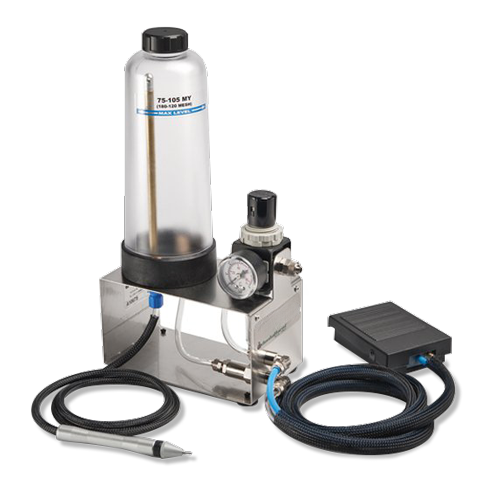
Foot pedal control
Allows the jet to be activated while maintaining greater manual control over the micro-projector.
Ergonomic micro-projector
The pen-like shape allows progressive operations and precise detail control.
Compatibility with fine abrasives
It can use aluminium oxide and glass beads to obtain different results depending on the operation.
How Micro Blaster works
Micro Blaster uses a pressure micro-sandblasting system. Compressed air carries the abrasive towards the micro-projector, generating a concentrated and controllable jet.
The operator can adjust working pressure, abrasive, grain size, nozzle diameter and distance from the surface according to the desired result.
For greater safety and control, the treatment can be carried out inside a box or cabinet.
Main components
-
Compact machine body
Integrates the adjustment and control elements while maintaining a reduced overall size.
-
Micro-projector
Directs the abrasive flow onto the area to be treated with high precision.
-
Foot pedal control
Allows the jet to be activated without losing manual control of the micro-projector.
-
Air filter and pressure regulator
Allow treatment intensity and incoming air quality to be controlled.
-
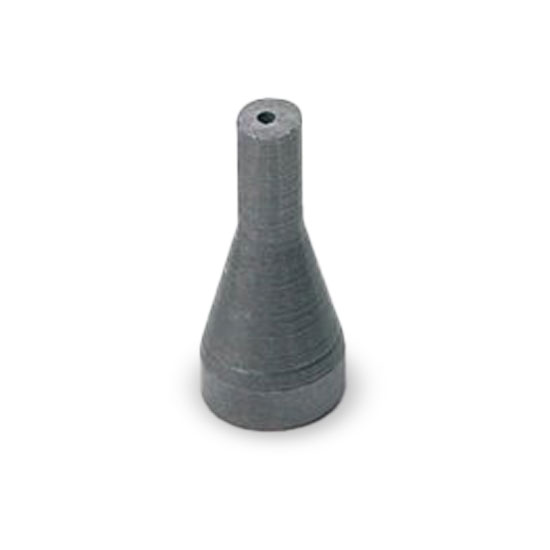
Tungsten carbide nozzle
Ensures wear resistance and abrasive jet precision.
Usable abrasive materials
-
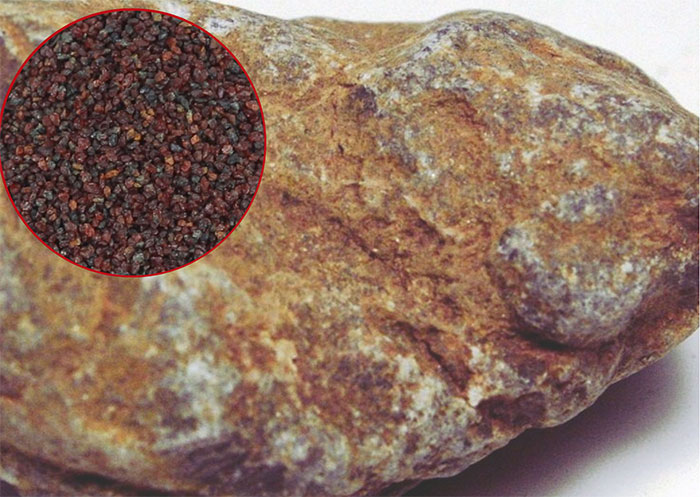
Aluminium oxide
Suitable for obtaining controlled surface roughening and a stronger abrasive action.
-
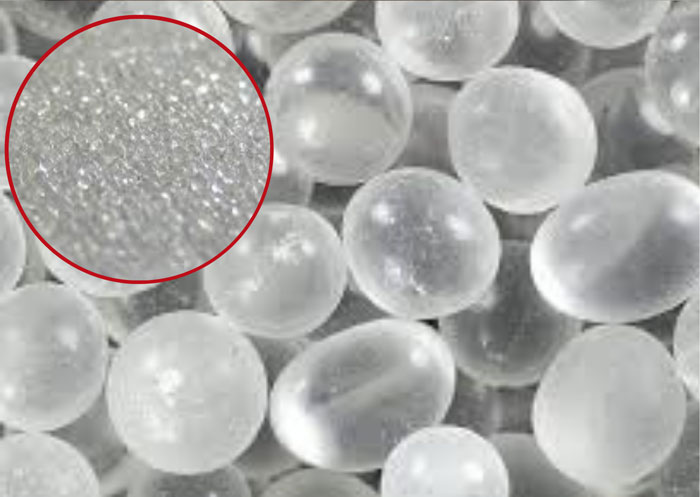
Glass beads
Allow a softer and more uniform satin finish.
-
Specific abrasives
Additional grain sizes are available according to the type of operation required.
Usable single-use abrasives:
AL2O3 150 (95 µm) - AL2O3 180 (85 µm) - MICROBLAST 90 µm
Additional grain sizes are available on request by replacing nozzle and abrasive dosing unit.
Available nozzles
Standard ø 0.8 mm tungsten carbide nozzle.
ø 0.5 / 1.2 / 1.5 / 2.0 mm nozzles available on request.
The choice of nozzle depends on abrasive, grain size, material to be treated and required precision.
Difference between Micro Blaster and a traditional sandblaster
Micro Blaster does not replace a free-blasting sandblaster for large surfaces or high-removal work.
It is designed for precision operations on details, delicate artefacts, small components and surfaces that require a highly controlled jet.
Compared to a traditional sandblaster, it offers greater precision, a smaller impact area, use with fine abrasives and better adaptability to laboratory and restoration work.
Usage recommendations
Before using Micro Blaster, it is important to define the material to be treated, abrasive, grain size, operating pressure and nozzle diameter.
On delicate surfaces, it is advisable to proceed with progressive tests, starting from conservative parameters.
To keep jet quality consistent, it is important to periodically check nozzle, filter, fittings, dosing unit and compressed air quality.
FAQ about the Micro Blaster micro-sandblaster
Is Micro Blaster a micro-sandblaster?
Read the answer
Yes. It is a compressed-air micro-sandblaster designed for precision operations on delicate surfaces and small components.
What is a micro-sandblaster used for?
Read the answer
It is used to remove deposits, oxides, residues and surface contamination from small areas and delicate details.
Is Micro Blaster suitable for restoration?
Read the answer
Yes. It is suitable for restoration work on wooden artefacts, stone materials, mosaics, frescoes and delicate surfaces.
Which abrasives can it use?
Read the answer
It can use aluminium oxide, glass beads and specific abrasives for micro-sandblasting.
What is the standard nozzle?
Read the answer
The standard Micro Blaster nozzle is 0.8 mm in tungsten carbide.
Does Micro Blaster have foot pedal control?
Read the answer
Yes. The foot pedal control allows the jet to be activated while maintaining control of the micro-projector.
What is the difference compared to a traditional sandblaster?
Read the answer
Micro Blaster is designed for precision, details and small surfaces, while a traditional sandblaster is more suitable for large surfaces and heavy removal operations.