 , Portable Sandblasting
 , Micro sandblasters
 , Graffiti removal
 , Conservative Cleaning
 , Building
 , Cleaning
 , Industry
 , Nautical
 , Stone
 , Bodywork

SABIX Hybrid
SABIX Hybrid is a professional blasting machine designed for operations that require greater removal capacity, but with a more controlled approach than traditional abrasive blasting.
Hybrid technology combines two different actions: on one side, dry ice helps detach the contaminant through impact and thermal shock; on the other, the abrasive adds a mechanical component that increases effectiveness on more difficult surfaces.
This synergy generates a BOOSTER effect in the jet, useful when dry ice blasting alone is not sufficient and when a fully abrasive process would produce too much dust, too much residue or more demanding jobsite management.
SABIX Hybrid is particularly interesting for industrial work, heavy-duty maintenance, construction, metal fabrication, marine applications, the railway sector, plants, metal structures and surfaces where it is necessary to find a balance between power, operational control and reduction of secondary residues.
SABIX Hybrid in action
Hybrid technology combines dry ice and abrasive to increase removal capacity while maintaining greater operational control compared to traditional abrasive blasting.
Where to use SABIX Hybrid
SABIX Hybrid is suitable for professional applications that require powerful removal, but in a cleaner and more controlled way than conventional abrasive systems.
-
Industry and maintenance
Suitable for removing production residues, encrustations, old paints, oxidation and contamination from machinery, plants, metal structures and industrial components.
-
Metal fabrication and metal surfaces
Useful for working on iron, steel, frames, structures, metal parts and surfaces that must be prepared before a new painting or protective coating cycle.
-
Marine and shipbuilding sector
Suitable for operations on hulls, components, metal structures, parts affected by oxidation, stubborn residues or old coatings.
-
Construction and mineral surfaces
It can be used on stone, concrete, brick, mineral coatings and construction substrates when more effective removal is required compared to a simple low-intensity process.
-
Railways, heavy vehicles and large structures
Hybrid technology is suitable for contexts where complex surfaces, robust components, resistant paints, oxidation or difficult contaminants must be treated.
-
Industrial restoration and recovery of manufactured items
When the item allows for a more aggressive process, SABIX Hybrid makes it possible to modulate the action of the jet by combining solid CO₂ and abrasive according to the required result.
Hybrid blasting with BOOSTER effect
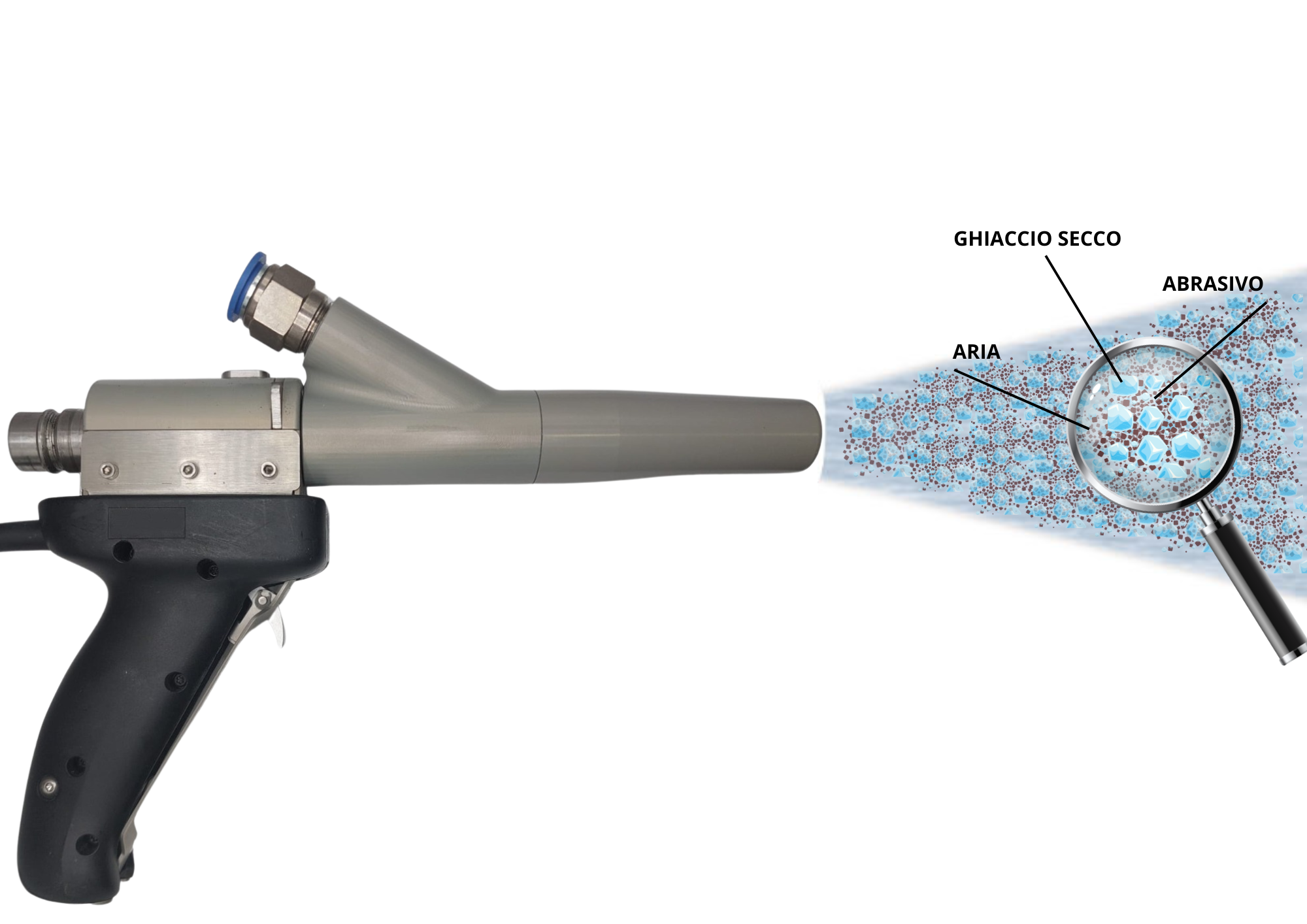
The combination of dry ice and abrasive increases the effectiveness of the jet.
Dry ice helps detach the contaminant through thermal shock and sublimation, while the abrasive adds mechanical force, improving removal capacity on more difficult surfaces.
Compared to a fully abrasive blasting process, the hybrid system uses a reduced amount of abrasive media, helping to contain dust, secondary residues and jobsite management requirements.
Operational strengths
Less dust than traditional abrasive blasting
The predominant use of solid CO₂ pellets and a reduced amount of abrasive help contain dust generation compared to a fully abrasive process.
Reduction of secondary residues
Dry ice sublimates after impact and leaves no solid residue. What remains is mainly the removed contaminant and the portion of abrasive used.
Dry process
SABIX Hybrid does not require water during the process. This avoids drying times and limits issues related to moisture.
Greater process control
The mixture of solid CO₂ and abrasive makes it possible to adapt jet intensity, aggressiveness and removal capacity to the treated material.
Lower impact on the jobsite
Compared to traditional abrasive blasting, hybrid technology can reduce dispersion, residues and the time required to manage the work area.
Solution suitable for complex jobs
SABIX Hybrid is designed for operations where power, continuity and removal capacity are required, together with more orderly management of the working environment.
How hybrid blasting works
Hybrid blasting uses two elements in combination:
DRY ICE PELLETS
Dry ice helps detach the contaminant through impact and thermal shock.
SELECTED ABRASIVE
The abrasive acts as mechanical support, increasing the energy of the jet.
COMBINED EFFECT
The synergy between solid CO₂ and abrasive improves removal capacity on more resistant residues.
The main difference compared to traditional abrasive blasting is that the abrasive is not the only key element of the process.
The predominant presence of dry ice makes it possible to reduce the amount of solid material used and simplify residue management.
Difference between SABIX Hybrid, traditional abrasive blasting and pure dry ice blasting
SABIX Hybrid is positioned between dry ice blasting and traditional abrasive blasting.
Dry ice blasting is ideal when the goal is to work without water, without chemical products and without residue from the main media.
However, on some very stubborn contaminants, it may be necessary to increase the removal force.
Traditional abrasive blasting offers high abrasive capacity, but it can generate more dust, more material to recover and more demanding management of the work area.
SABIX Hybrid was created to combine the strengths of the two systems: it uses dry ice as the predominant element and integrates abrasive only where greater aggressiveness is required.
Components and operating logic
SABIX Hybrid must be configured according to the type of operation, the surface to be treated, the required degree of removal and the availability of compressed air.
- Dry ice pellet feeding
- Abrasive dosing
- Working pressure
- Available air flow rate
- Type of nozzle
- Working distance
- Grit size and nature of the abrasive
- Resistance of the material to be treated
- Amount of residue to be removed
- Need to contain dust and dispersion
Correct system adjustment is essential to achieve the best balance between effectiveness, material consumption, surface quality and control of the working environment.
Usage recommendations
To achieve the best result with SABIX Hybrid, it is important to start from an assessment of the substrate and the contaminant to be removed.
On delicate or non-homogeneous surfaces, preliminary tests are recommended, progressively adjusting pressure, distance and abrasive percentage.
When the goal is to reduce dust and residues, it is useful to work with the lowest amount of abrasive compatible with the required result.
The choice of pellet, abrasive and nozzle must be defined according to the material, the hardness of the contaminant and the desired finish level.
During professional use, it is important to periodically check nozzles, hoses, fittings, gun, dosing systems and components subject to wear.
Hybrid technology combines dry ice and abrasive to increase removal capacity while maintaining greater operational control compared to traditional abrasive blasting.
SABIX Hybrid FAQ
What is SABIX Hybrid?
Read the answer
SABIX Hybrid is a hybrid open-blasting machine that combines dry ice pellets and abrasive.
It is designed to increase removal effectiveness compared to dry ice alone and reduce dust and residues compared to traditional abrasive blasting.
When is it convenient to use a hybrid blasting machine?
Read the answer
It is convenient when dry ice blasting alone is not aggressive enough and when fully abrasive blasting would generate too much dust, too much residue or more complex jobsite management.
Does SABIX Hybrid use water?
Read the answer
No. The system works dry, using solid CO₂ pellets and a controlled abrasive.
This avoids drying times and reduces issues related to moisture on the surface.
Does hybrid blasting leave residues?
Read the answer
Dry ice sublimates and leaves no solid residue.
The material removed and the portion of abrasive used remain to be managed, normally less than in a fully abrasive process.
Can SABIX Hybrid replace a traditional sandblaster?
Read the answer
It depends on the type of work.
SABIX Hybrid is suitable when a balance is needed between removal power, dust reduction and better residue management.
For some highly abrasive operations, a traditional sandblaster may remain more suitable; for other operations, hybrid technology can offer an important operational advantage.
Which materials can be treated with SABIX Hybrid?
Read the answer
It can be used on metal, industrial structures, components, mineral surfaces, manufactured items, marine parts and resistant substrates.
Compatibility must always be assessed according to material, contaminant, abrasive and working pressure.
Is a specific compressor required?
Read the answer
A compressor suitable for the air flow rate required by the selected configuration is needed.
The assessment must consider pressure, real air flow rate, nozzle, working distance and jet continuity.
Is SABIX Hybrid suitable for removing paint and oxidation?
Read the answer
Yes, it is suitable for removing paints, oxidation, encrustations and stubborn residues, especially when it is useful to increase jet effectiveness while maintaining more controlled management compared to traditional abrasive blasting.
Dedicated Instagram channel