
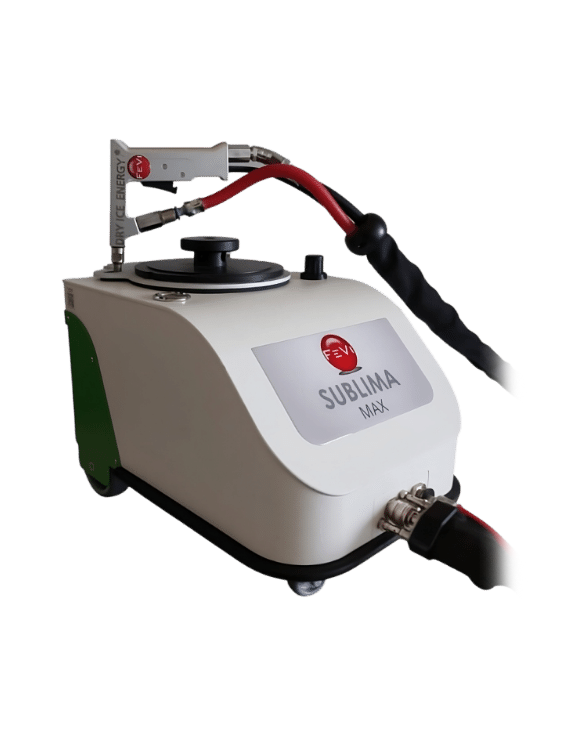
 , Portable Sandblasting
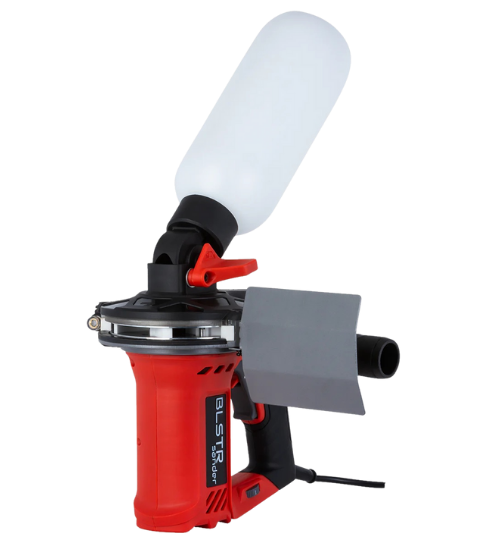
 , Micro sandblasters
 , Graffiti removal
 , Building
 , Cleaning
 , Industry
 , Nautical
 , Stone
 , Bodywork

FEVI open blasting machines
Open blasting machines use compressed air to project abrasive material directly onto the surface to be treated.
They are among the most versatile blasting systems and are used where it is necessary to work freely on surfaces, components and structures of different shapes and sizes.
The operator can direct the abrasive stream without the blasting gun having to remain in contact with the surface. This makes the technology particularly suitable for removing rust, paint, oxidation and residues, preparing surfaces before painting, treating iron, steel, wood, stone, concrete, marble and glass, and for numerous applications in construction, industry, maintenance and restoration.
Pressure, airflow, abrasive, particle size and nozzle diameter must nevertheless be selected according to the work to be carried out.
To view the available models and configurations directly, visit the FEVI open blasting machines
What is an open blasting machine?
An open blasting machine is a machine in which abrasive is accelerated by compressed air and projected through a nozzle directly onto the surface.
The term open blasting refers to the fact that the abrasive stream is freely directed by the operator and is not immediately recovered through a vacuum head maintained in contact with the material.
This makes it possible to reach:
- flat surfaces;
- corners;
- profiles;
- tubular structures;
- fabricated metalwork;
- decorative elements;
- irregular geometries;
- components of different sizes.
The ability to direct the abrasive stream freely is one of the main differences compared with abrasive recovery blasting machines.
How does an open blasting machine work?
In professional pressure blasting machines, the abrasive is contained inside a pressurised vessel.
During operation:
- compressed air supplies the machine;
- abrasive is metered into the air stream;
- the air-abrasive mixture travels through the hose;
- the flow is accelerated through the nozzle;
- the abrasive strikes the surface;
- the mechanical action removes or modifies the surface layer.
The effectiveness of the process therefore does not depend on pressure alone.
The result comes from the combination of:
pressure + airflow + abrasive + particle size + nozzle diameter + distance + working angle.
Changing just one of these elements can significantly alter removal capacity, productivity and finish.
Pressure blasting and open blasting: are they the same thing?
The two terms describe different aspects.
Pressure blasting indicates the system used to feed the abrasive: the material is contained inside a pressurised vessel and is forced into the circuit.
Open blasting instead describes the way in which the abrasive stream reaches the surface: the abrasive is projected freely without being recovered directly by the blasting gun.
A blasting machine can therefore be both:
pressure-fed + open blasting.
This configuration is particularly common in professional applications because it combines good removal capacity with considerable operating freedom.
Difference between pressure and suction blasting machines
In a pressure blasting machine, abrasive and air are conveyed towards the nozzle through a pressurised circuit.
In a suction blasting system, by contrast, the abrasive is drawn into the air stream by suction, generally using the Venturi effect.
The two technologies can offer different characteristics in terms of:
- quantity of abrasive conveyed;
- removal capacity;
- air consumption;
- adjustment options;
- productivity.
For professional treatment of large surfaces or where significant removal capacity is required, pressure systems are frequently used.
What are open blasting machines used for?
The versatility of the abrasive stream allows these blasting machines to be used for numerous applications.
Rust removal
On iron and steel, abrasive blasting can remove oxidation and rust, preparing the material for subsequent operations or protective treatments. Treatment intensity must be adapted to the thickness of the component and the condition of the surface.
Removal of paint and coatings
Open blasting machines can be used to remove old layers of paint and coatings. The difficulty of the operation depends on the thickness, composition and adhesion of the material to be removed.
Preparation before painting
Abrasive blasting can remove contamination and modify the surface profile before a new coating is applied. The resulting surface must be suitable for the protective coating system that will subsequently be used.
Restoration
Controlled pressure, selected abrasives and suitable nozzles allow the technology to be used in numerous restoration applications. In these cases, control generally takes priority over maximum removal capacity.
Decoration and engraving
Glass, marble, granite, stone and other materials can be treated using specific stencils and abrasives to produce lettering, decorations and engravings.
Creating surface effects
By varying the abrasive and operating parameters, the texture of certain surfaces can be modified to obtain different degrees of roughness or matt finish.
Open blasting machines for iron and steel
Iron and steel are among the most common applications.
Typical operations include:
- railings;
- gates;
- fabricated metalwork;
- metal structures;
- frames;
- mechanical components;
- wheels;
- machine parts.
Open blasting is particularly useful on structures with complex geometries because the operator can direct the nozzle towards edges, profiles, welds and areas that are difficult to reach with a vacuum head.
On thin sheet metal, however, treatment intensity must be controlled carefully to avoid alteration or deformation.
Open blasting machines for wood
Blasting wood requires different parameters from those used for metals.
The abrasive stream can be used on:
- beams;
- shutters;
- window frames;
- doors;
- furniture;
- wooden structures;
- old finishes.
Softwoods and hardwoods react differently.
Excessively aggressive treatment can remove softer fibres more rapidly and produce a pronounced grain effect.
Pressure, abrasive and distance must therefore be adjusted according to the required effect.
Stone, marble and granite
Open blasting machines can also be used in the stone sector for treatment, engraving and processing of natural stone.
Marble, granite, sandstone and other materials nevertheless have very different characteristics.
For decorative work and memorial art, stencils can also be used to protect the areas that must not be engraved.
The correct configuration should take into account material hardness, required depth, abrasive and level of detail.
Cement, concrete and construction applications
In construction, abrasive blasting can be used on cement, concrete, brick, stone and metal structures.
Open blasting is particularly useful where the surface is large or has geometries that are difficult to reach.
Before treatment, the following should be assessed:
- condition and consistency of the substrate;
- material to be removed;
- required treatment depth;
- abrasive;
- conditions of the working area;
- management of abrasive and dust.
Glass frosting and treatment
Glass can be treated using specific abrasives and parameters to create satin effects, frosting, decorations and engravings.
Stencils make it possible to protect selected areas and create graphic patterns.
Particle size, pressure and distance must be controlled to achieve uniformity and definition.
What are the main advantages of open blasting?
Freedom of movement
The operator can direct the nozzle freely and reach surfaces of different shapes.
Versatility
The same technology can be configured for very different materials and processes by changing the abrasive and operating parameters.
Removal capacity
Professional pressure systems can provide significant abrasive action where the application requires it.
Ability to treat large surfaces
The absence of a vacuum head held against the surface allows the operator to work freely along large structures and surfaces.
Access to complex geometries
Profiles, corners, edges and complex structures can be reached more easily.
Different levels of operating autonomy
Blasting machines can be configured with vessels of different capacities according to operation duration and required productivity.
What are the limitations of open blasting machines?
The main factor to consider is the dispersion of abrasive and dust.
The projected material is not recovered directly by the blasting gun and must therefore be managed within the working environment.
For this reason, the following should be assessed:
- location of the operation;
- containment;
- ventilation;
- operator protection;
- abrasive collection;
- nature of the dust;
- possible use of dust-control systems.
For some applications, an abrasive recovery system, blasting cabinet or water-assisted technology may therefore be more appropriate.
Open blasting or abrasive recovery blasting?
The choice depends mainly on the application.
| Feature | Open blasting | Abrasive recovery blasting |
|---|---|---|
| Freedom of movement | High | More restricted by the recovery head |
| Complex geometries | Particularly suitable | To be assessed |
| Immediate abrasive recovery | No | Yes |
| Large surfaces | Particularly suitable | Depends on required productivity |
| Localised operations | Yes | Particularly suitable |
| Control of dispersion | Requires management of the working area | Greater |
| Need to hold a head against the surface | No | Generally yes |
There is therefore no universally better technology.
Open blasting prioritises freedom and productivity, while abrasive recovery blasting prioritises control of material in the working area.
How to choose blasting-machine capacity
Vessel capacity mainly affects operating autonomy.
A compact machine is easier to move but requires more frequent refilling.
A blasting machine with a larger vessel may instead be preferable when:
- the surface is large;
- operations are prolonged;
- the number of refills needs to be reduced;
- the machine is used mainly in a stable working area.
The choice should therefore not be based on the assumption that larger is always better.
Mobility and autonomy should be balanced according to the application.
FEVI open blasting range
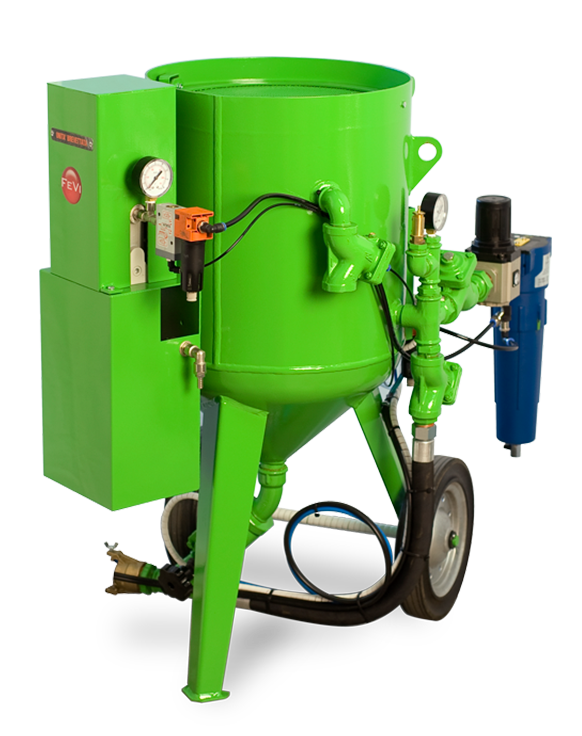
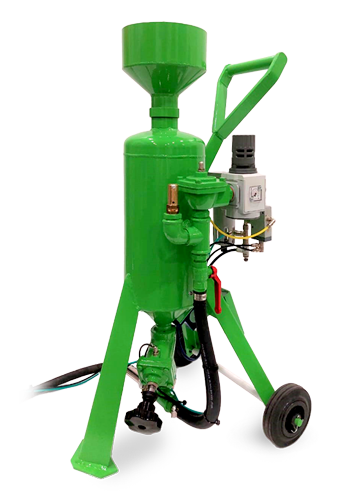
The FEVI range includes different open blasting configurations, from compact portable machines to systems offering greater operating autonomy. The range includes models such as SABIX 8, SABIX 28, SABIX 120, SABIX 200, Transformer, Waterblast, SABIX Hybrid and SABIX R.
SABIX 8
SABIX 8 prioritises compact dimensions and ease of handling and is suitable for localised operations, maintenance, construction and restoration.
SABIX 28
It provides greater operating autonomy than more compact systems and can be used where portability needs to be combined with greater continuity of work.
SABIX 120 and SABIX 200
The larger capacities are intended for applications where operating autonomy and cycle duration are particularly important.
Transformer
The Transformer family supports professional operations with different configurations and capacities.
Waterblast and SABIX Hybrid
These solutions extend the possibilities of open blasting with specific configurations for applications where dust management and alternative treatment methods are particularly important.
SABIX R
SABIX R combines portability with the possibility of using different operating modes according to the application.
How to choose the abrasive
The abrasive is one of the elements that most strongly influence the result.
Selection depends on:
- surface material;
- residue to be removed;
- required finish;
- hardness;
- particle size;
- particle shape;
- nozzle size.
Depending on the machine and application, suitable abrasives may include olivine, aluminium oxide, glass beads, ceramic beads, metallic grit and other specific media.
A particularly hard, angular abrasive behaves differently from a finer or more rounded medium.
For this reason, the abrasive should not be selected solely according to the blasting machine.
Abrasive particle size
Abrasive particle size and nozzle diameter must be compatible.
Material that is too coarse for the available passage can cause irregular flow or blockages.
Different particle sizes also affect:
- removal capacity;
- working speed;
- surface profile;
- consumption;
- finish.
Before an important operation, it is advisable to carry out a test using the actual material intended for the process.
How important is compressed air?
Compressed air is fundamental to the performance of an open blasting machine.
The most important parameter is not simply compressor power expressed in HP or kW, but the actual airflow available at the operating pressure.
Air consumption increases significantly as nozzle diameter increases.
An undersized compressor can cause:
- pressure drop;
- loss of productivity;
- less consistent flow;
- difficulty maintaining stable operating parameters.
Before selecting the blasting machine, compressor and nozzle should therefore be assessed together.
Nozzle and productivity
The nozzle transforms the air and abrasive flow into the abrasive stream used for treatment.
Its diameter directly affects the amount of air required.
A larger nozzle can increase working capacity but requires a compressor with sufficient airflow.
Wear must also be considered.
The nozzle's internal bore progressively increases during use, which can result in higher air consumption than originally expected.
Operating pressure
Higher pressure does not always mean better treatment.
The correct value depends on the material and the required effect.
A robust metal structure with a resistant coating may require different parameters from wood, stone or more delicate components.
The most appropriate method is to start with a conservative configuration and progressively increase the intensity until the required result is achieved.
Distance and abrasive-stream angle
Operator technique can also significantly affect the result.
Reducing the distance generally makes the abrasive stream more concentrated.
Increasing the distance distributes the energy over a larger area.
The angle of incidence changes the way in which the abrasive particles strike the surface.
The combination of distance, angle and travel speed should remain as consistent as possible to achieve uniform treatment.
Dust reduction with Acquablast
FEVI open blasting systems can also be equipped with Acquablast, an abrasive-stream humidification system designed to help reduce airborne dust during blasting.
Water is introduced close to the abrasive stream and the quantity can be adjusted according to the operation.
Its use should be assessed considering:
- compatibility of the surface with water;
- working environment;
- subsequent treatments;
- drying possibilities;
- any sensitivity of the material.
Humidification helps manage dust but does not automatically eliminate all particles generated by the process.
Operator protection
Open blasting involves projecting abrasive at high velocity and can generate dust from both the blasting medium and the surface being treated.
Protective equipment appropriate for the specific application and associated risk assessment must therefore be used.
The FEVI range also includes equipment specifically intended for operator protection during abrasive blasting operations, including blasting helmets and respiratory-protection solutions.
Selection of the protective equipment should take into account the abrasive, contaminants present on the surface, working environment and method of operation.
Maintenance of an open blasting machine
Abrasive and compressed air progressively wear certain components.
It is important to periodically inspect:
- nozzle;
- abrasive hose;
- fittings;
- blasting gun or nozzle holder;
- valves;
- metering system;
- seals;
- pressure vessel;
- condensate separator.
Nozzle wear can directly affect air consumption and machine behaviour.
Air moisture should also be controlled because it can interfere with consistent abrasive flow.
When should you choose an open blasting machine?
Open blasting is particularly suitable when the following are required:
- freedom to direct the nozzle;
- ability to reach complex geometries;
- ability to work on large surfaces;
- high versatility;
- worksite operations;
- treatment of structures that cannot be moved;
- different levels of capacity and operating autonomy.
Where the priority is instead to recover abrasive and dust directly during a localised operation, an abrasive recovery blasting machine may be more appropriate.
Frequently asked questions about open blasting machines
What does open blasting machine mean?
Discover the answer
It means that the air-abrasive stream is projected freely onto the surface without a vacuum head immediately recovering the material.
How does an open blasting machine work?
Discover the answer
Compressed air conveys and accelerates the abrasive through a nozzle. The material strikes the surface, producing a mechanical action that can remove coatings, rust and oxides or modify the finish.
What is the difference between open blasting and abrasive recovery?
Discover the answer
In open blasting, material is projected into the working environment. In abrasive recovery blasting machines, the working head incorporates an extraction system that recovers abrasive and dust directly from the surface.
Which compressor is required?
Discover the answer
It depends mainly on nozzle diameter and operating pressure. The compressor's actual airflow should be checked and compared with the air consumption of the selected configuration.
Which abrasive should be used?
Discover the answer
It depends on the surface and required result. Hardness, shape and particle size affect removal capacity and finish.
Can wood be blasted?
Discover the answer
Yes, using appropriate pressure and abrasive. Treatment must be adjusted carefully because excessively aggressive action can significantly modify the surface structure.
Can open blasting be used to remove rust?
Discover the answer
Yes. Iron and steel are among the most common applications, but treatment intensity and abrasive must be selected according to the component.
Does a larger blasting machine always work better?
Discover the answer
No. A larger vessel mainly increases operating autonomy. Productivity and result also depend on nozzle, compressed air, abrasive and operating parameters.
How can dust be reduced?
Discover the answer
Dust can be managed through appropriate organisation and containment of the working area, environmental extraction or abrasive-stream humidification systems where compatible with the application.
When is an abrasive recovery blasting machine preferable?
Discover the answer
When limiting abrasive and dust dispersion is important and the surface allows the vacuum head to operate correctly.
Open blasting machines: choose the technology first, then the model
The correct choice starts from the work to be carried out.
The following should be assessed:
surface → material to be removed → size of the operation → environment → abrasive → nozzle → compressed air → operating autonomy.
Only then is it possible to identify the appropriate machine capacity and model.
This page explains the operation and applications of open blasting machines. To compare the available FEVI models, features and configurations, visit the dedicated page.